Posts

Membranophone and other sound activities

Image
Kids were given tasks to find out 1. Why animals such as rabbits, deer and fox have two long rotating ears? (rotates independently to hear sound from all directions). 2. How mammals such as whales and bats use their listening skills for echo location? Echo location Echo location is the use of sound waves and echoes to find the location of objects in space. Bats use this to navigate and find food in the dark. To echo locate, they produce sound waves through nose or mouth, which when hit by an object produces echoes. Bats listen to the echoes and figure out the shape, size and the location of the prey. Even dolphins use the same technique to find food and navigate in the dark. Dolphins produce high frequency clicks that quickly travel through water. In fact, sound waves travel five times faster in water than they do through air.  After a healthy amount of interaction about animals,  it was time to test it why we have two ears, and how it helps in our hearing. ...
Simple Sound Activities

Image
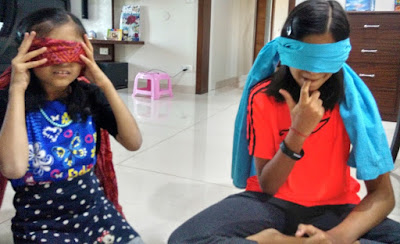
We started our first activity by simply listening to the sounds around us both near and far. We then blindfolded our eyes and tried listening to the same sounds again. Kids were able to observe keenly and also answer 1. What were the sounds they heard? 2. How far the sound was coming from and also the direction it was coming from? 3. What object was making the sound? They also realized that their listening ability was much better when blindfolded. We then discussed about how different shapes of animal ears  such as rabbit, elephants, dogs, cats are, their functions  and how they use it. We talked about echo location used by  bats and aquatic animals such as dolphins, whales too. To test their keen listening and observing skills we did the following activity. Materials needed  1. Plastic  cup 2. glass cup 3. Melanine cup 4. Stainless steel cup 5. small knife or a fork Procedure 1. Blind fold one student . 2. Lightly tap one glass...

Peek into the beginnings of a bean stalk!

Image
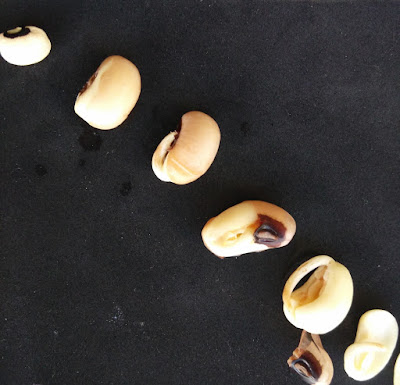
Stages of bean growth After few weeks of doing experiments indoors, it was time for a field trip. Kids were all excited and had come prepared wearing shoes, cap and a bag to carry vegetables etc. Before heading out, we had a small discussion around 1. What are different ways plants grow?. 2. How vegetables, pulses, fruits grow? 3. What are different forms of cultivation? Then, it was time for some hands on learning : A demo of bean seed growing. The kids looked at the soaked sprouted  black eyed  bean and other soaked beans too. They recollected  seeing their moms grow sprouted green gram (belonging to the legume family).  The sprouted green gram Over night soaked beans   We opened one black eye bean to find how the baby plant starts growing inside the sprouted bean. It was now easy for the kids to compare the sprout to the diagram. They could see each and every part of the bean sprout and unde...

Balancing stick - rotational Inertia

Image
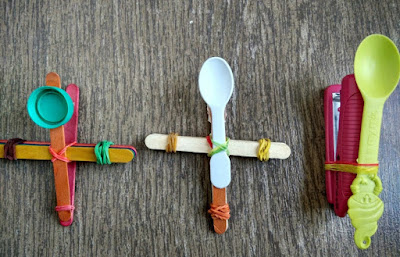
"Sorry, for coming late " said the kid who was panting . When I asked him "What happened, that got you delayed?". He said "I was running back from the shop and couldn't stop myself from running even after coming closer home". " Wonderful! you  just experienced  something called inertia in physics, dear" I replied. And that's how the class started this week. What is Inertia?. Inertia  is the tendency of  a body to resist any change in motion or at rest. This can be explained with a simple example. When a vehicle stops,  you tend to jerk forward before coming to a stop. Also, when a vehicle starts you tend to jerk backward. What is rotational Inertia? Rotational inertia measures how much an object resists the change in rotation. Rotational inertia depends on the distribution of the mass in the stick. For example, when a sportsman is holding a bat (baseball) and swings it, he can swing quickly if he chokes the bat by reducing th...

Energy transfer

Image
Today, P came back home and was very excited. When I enquired about her excitement , she said "Today, we played games at school and I feel very energetic. So, tell me what experiments are we doing for the science activities". Till then I was not sure of the topic and so was still wondering what kind of activities to do. But, the word "energetic" gave me the idea of doing some experiments related to energy transfer. That's how it all started. We have  heard the word 'energy' quite a few times. But, let's see what it really means in physics. What is Energy? Energy is the measurement of the ability of something  to do any work.  It is not a material substance. Energy exists in many different forms such as light energy, mechanical energy, heat energy, sound energy, chemical energy, nuclear energy and so on. Though we hear so much about energy consumption, energy can never be created or destroyed. It can only be transferred from one form to...

Acids & Alkalis

Image
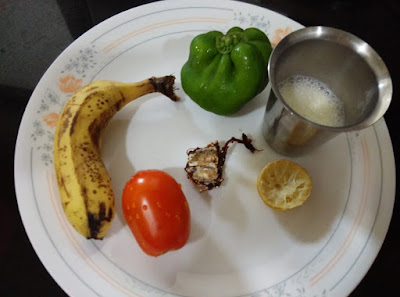
In our activity kids were shown a plate full of different food items. This plate mainly had items with different types of acids in them such as tamarind with tartaric acid, banana with malic acid etc., . After which we had a  discussion around why some items taste sour, salty,  bland etc. Also, in baking, how cake dough rises to become soft and fluffy, the chemical reactions that take place due to baking soda ( sodium bi carbonate) and buttermilk in the recipe. Kids were able to guess acids are sour and baking soda , baking powder are bases. Then we talked about what is pH (power of hydrogen) scale and what it means in chemistry. What is a pH scale ?  Scientists use the pH scale to measure how acidic or basic a liquid is. pH scale has a range from 0 to 14. From 0 to 7 are acids with 0 being the strongest acid. From 7 to 14 are bases with 14 being the strongest base. Since we can not be tasting every item to find out if it is a acid or base, the easi...

Mushy Banana

Image
Few days back, Reena had bought bananas and kept it near the dining table. That morning  she remembered that and told her daughter Sonia, to eat a banana while having her breakfast. As Banana is one of her favourite fruit, Sonia happily agreed to eat it without much fuss. But, as soon as she saw the banana , she refused to eat it. Curious to know what changed her mind Reena came to the kitchen and checked with her. She showed the banana and Reena knew the reason why Sonia did not want to eat. The skin of the banana had changed its  colour from yellow to brown and had lots of dark spots on it. The firmness of the banana had now turned to mushy banana. She wanted to know "what made the banana change its color and texture?". Do banana's always change color? Do all fruits change their color? She had so many questions. Do you also have many questions too?. Lets see one  at a time. How did the banana look before it ripened?. Can you guess it? Yes, it was g...