Posts

Energy transfer

Image
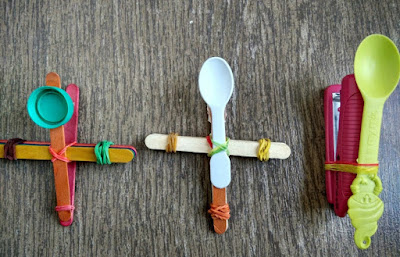
Today, P came back home and was very excited. When I enquired about her excitement , she said "Today, we played games at school and I feel very energetic. So, tell me what experiments are we doing for the science activities". Till then I was not sure of the topic and so was still wondering what kind of activities to do. But, the word "energetic" gave me the idea of doing some experiments related to energy transfer. That's how it all started. We have  heard the word 'energy' quite a few times. But, let's see what it really means in physics. What is Energy? Energy is the measurement of the ability of something  to do any work.  It is not a material substance. Energy exists in many different forms such as light energy, mechanical energy, heat energy, sound energy, chemical energy, nuclear energy and so on. Though we hear so much about energy consumption, energy can never be created or destroyed. It can only be transferred from one form to...
Acids & Alkalis

Image
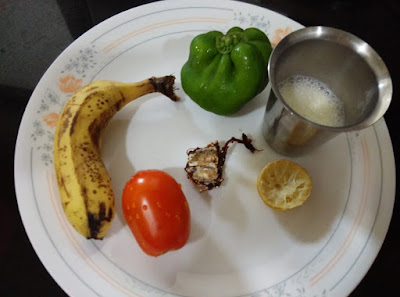
In our activity kids were shown a plate full of different food items. This plate mainly had items with different types of acids in them such as tamarind with tartaric acid, banana with malic acid etc., . After which we had a  discussion around why some items taste sour, salty,  bland etc. Also, in baking, how cake dough rises to become soft and fluffy, the chemical reactions that take place due to baking soda ( sodium bi carbonate) and buttermilk in the recipe. Kids were able to guess acids are sour and baking soda , baking powder are bases. Then we talked about what is pH (power of hydrogen) scale and what it means in chemistry. What is a pH scale ?  Scientists use the pH scale to measure how acidic or basic a liquid is. pH scale has a range from 0 to 14. From 0 to 7 are acids with 0 being the strongest acid. From 7 to 14 are bases with 14 being the strongest base. Since we can not be tasting every item to find out if it is a acid or base, the easi...

Mushy Banana

Image
Few days back, Reena had bought bananas and kept it near the dining table. That morning  she remembered that and told her daughter Sonia, to eat a banana while having her breakfast. As Banana is one of her favourite fruit, Sonia happily agreed to eat it without much fuss. But, as soon as she saw the banana , she refused to eat it. Curious to know what changed her mind Reena came to the kitchen and checked with her. She showed the banana and Reena knew the reason why Sonia did not want to eat. The skin of the banana had changed its  colour from yellow to brown and had lots of dark spots on it. The firmness of the banana had now turned to mushy banana. She wanted to know "what made the banana change its color and texture?". Do banana's always change color? Do all fruits change their color? She had so many questions. Do you also have many questions too?. Lets see one  at a time. How did the banana look before it ripened?. Can you guess it? Yes, it was g...

Hibernation

Image
Hibernation - not only bears Do you like to snuggle in your comforter when your mom is waking you up for the school bus during winter?. right.... Sure, if mom lets  you, you wouldn't mind sleeping for a long period of time, isn't it?. This is what happens to the bears. They  too love to hibernate during winter. Hibernate....What would that mean? Hibernation is when animals like bears, squirrels, hedge hogs go into sleep for longer period of time. During that period their body temperature drops very low, their metabolic rate also drops dramatically. They don't feel the need to eat food. Some of the animals like Bears munch on more food such as fish , before going into hibernation. Did you know that bumble bees hibernate?.  During winter after the worker bees and male drones die, the Queen bees go into hibernation close to 6 to 8 months under the dry leaves and wake up again during spring to build up their honey comb. Bats are other animals that ...

Why is the pool cold on a warm day and warm during the evening ?.

Image
  It was a cloudy day when me, P & P decided to get inside the pool around 6 pm. Since it was our summer break and didn't get a chance to go for a swim for a while we decided to go even though it started to drizzle a bit. We were mentally prepared to feel the water cold compared to outside temperature. Instead, what we experienced was that the pool was warm and when we stopped swimming and came out of the water it was cold. It was very intriguing to note that our assumptions were wrong. Even after I came back home and made a cup of tea the curiosity to understand why the pool water was warm compared to outside air was still lingering in my head. Suddenly, it dawned on me about the specific heat capacity of matters (water, air) I had studied during my school days and to confirm did a bit of reading and found the following. Since the specific heat capacity of water is very high compared to air the water absorbs the heat during the day and feels warm when you enter t...

Why fingers and toes shrivel after staying in the water for a while?

Image
The other day my daughter 'P" went for a swim with her friends for about 2 hrs. Though I had told her not to stay in the water for more than an hour she continued playing for long at the pool. When she came back home she was all worried about " why her fingers and toes were looking different?". To make her understand I explained about the 3 layers of the skin. The outer most tough layer is the epidermis which is made of dead keratin cells. Keratin is a kind of protein which is found in hair, nails and outer most layer of the skin. This is the layer that prevents the skin from water evaporation and protects the layer beneath it. When you stay in water for a long time epidermis which is made of dead keratin cells absorbs water and swells. This stretches the surface area of the skin attached to the living tissue. To accommodate this the skin wrinkles. Then she asked me a valid question why it happens only on our hands and feet and not on other parts of the...